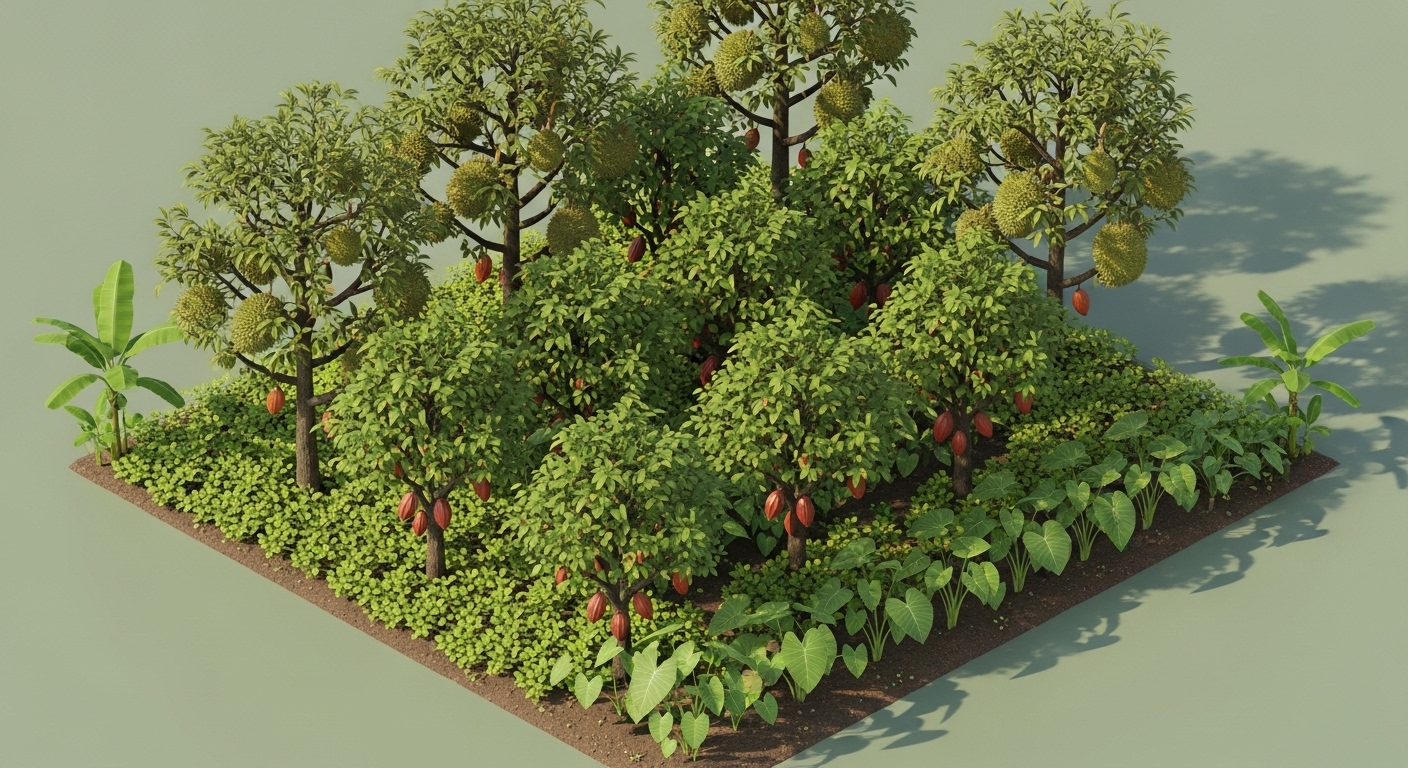
A Food Forest Design: Durian, Cacao, and Jackfruit
Durian, cacao, and jackfruit are three of my favorite things to eat. And the trees that produce them can work together beautifully in nature.
So, I’ve designed a food forest featuring durian, cacao, and jackfruit, along with perennial herbaceous layers like banana and taro. Such a forest design likely already exists today in various tropical zones of the world.
In any case, I am absolutely fascinated by the idea of the food forest because it mimics how nature works. So let’s get into it.
Fast plants stabilize soil, capture sunlight, and build fertility.
Slower, longer lived trees establish themselves quietly underneath.
Durian and jackfruit are long lived canopy trees that eventually want full sunlight.
Cacao, by contrast, evolved as an understory tree. It prefers filtered light, stable humidity, and protection from harsh exposure.
When placed together correctly, they are collaborators across time and height.
Pigeon pea is planted as a short lived nitrogen fixer. It improves soil fertility quickly and thrives in open sun.
Banana grows fast and creates a humid, shaded microclimate that shelters young durian and cacao seedlings.
At ground level, peanut and taro spread across the soil, protecting it from erosion, retaining moisture, and producing food.
All of these plants can be established at the same time. The system does not require waiting for perfect soil. Fertility begins accumulating immediately through living roots, fallen leaves, and microbial activity. An integrated system.
Species overlap, growth is rapid, change is constant.
Each element plays a role for a season, a decade, or a lifetime. Productivity comes not from domination, but from timing. This is what it means to work with nature. We do not force things. We create the conditions, and then we allow the forest to arrive, and then, the fruits.
Leave a Reply