 PerillaCove
Writing

The Cove City
Drafting this island took me more iterations than usual, but here is a story of human agency and its relationship to an ideal but plausible living structure I call the Cove.
We will travel from the intangibles of the heart and soul, to the most practical elements of a functional city, and come full circle.
I will begin with the Human, the multi-faceted centre of mass that makes this all possible.
Once upon a time, we were all Human. We could grow food, build a shelter, mend a tool, read the sky, slaughter an animal, weave a basket, and tell a story. We had our eyes on life, and we were complete. We knew what our effort produced because we ate it, wore it, sat inside it.
If two of us were in a Cove, alone, whatever is made gets used. Whatever is given comes back, maybe later, maybe in a different form. The loop closes on its own. There is no rift between production and consumption, and we capture the totality of both in a series of swift, integrated motions, like the flawless turnover of nature itself.
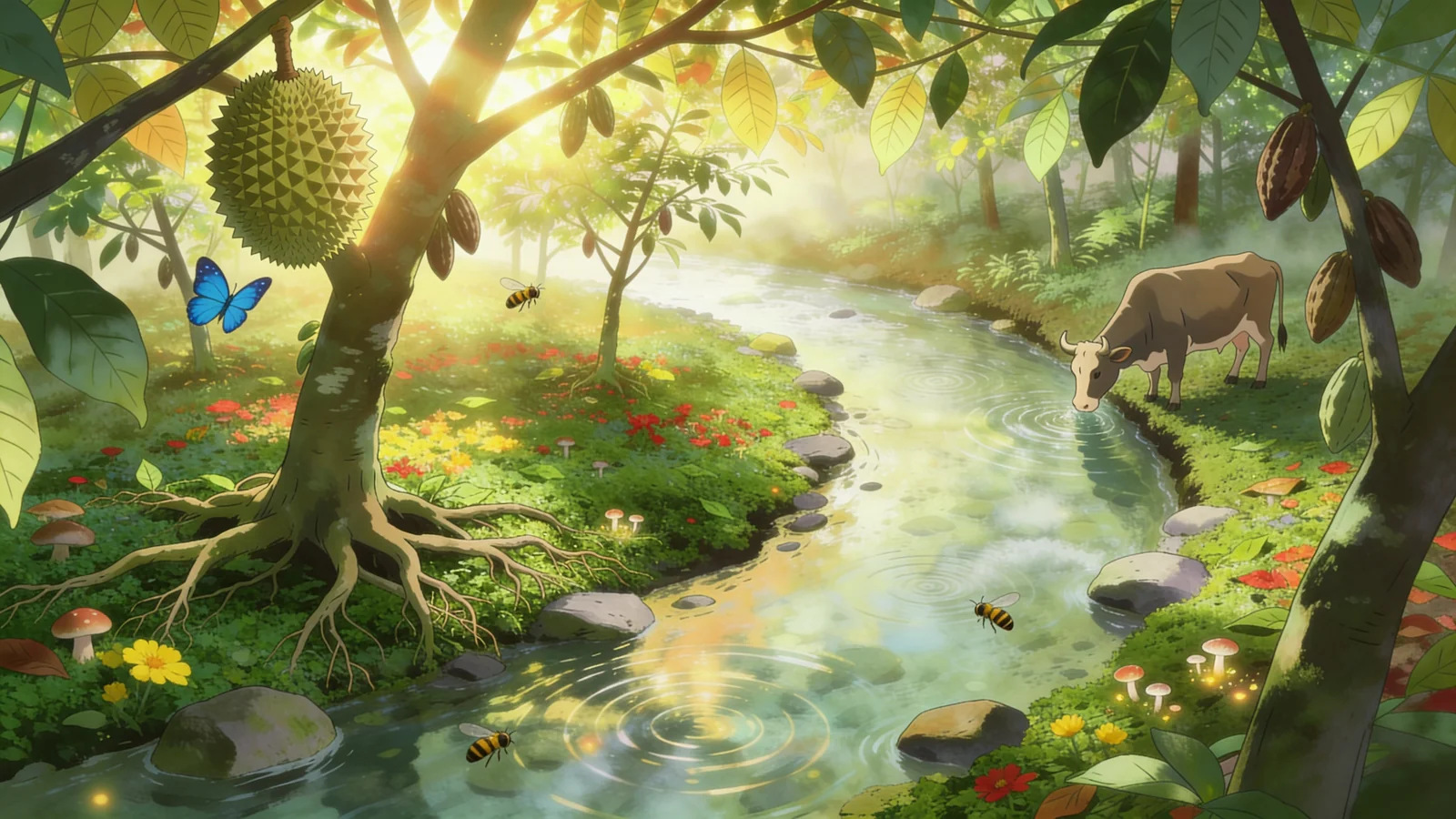
The Cove works not necessarily because each person specialized, but because each person is Whole. And the exchange between them is incidental to lives that are already close to nature. This is the bedrock.
Heart of the city
At scale, the Cove becomes the one and only blueprint for a perfect city. It combines nature, integrated gastronomy, melodious music, free-form movement, and elegant software into something cohesive, decentralized, and abundance-producing.
A little place where everyone is a master of their own lives, exercising their unique abilities ... like different lifeforms in a forest, from shrub to tree to bird to snail. Integrated, decentralized, and resilient. The way nature intended.
Small and dedicated population. Each of us holds a set of intangible skills. We build systems, leverage, to directly exchange soft and hard value on demand. Food, music, entertainment, homes …
Money is thus made independent of the hours worked. In fact it’s not really work that we are doing; the repetitive parts of physical and intellectual labor are handled by AI. We instantiate our insights by directing technology with precision.
Taxation does not exist because the place funds itself through projects and partnerships with all of us. It is a positive-sum lattice free of administrative baggage. We communicate, transact, and build relationships directly with each other, for everything, without intermediaries or obstacles.
Transportation is rapid and extensive and built according to a democratic vote. Such a project can prevent or deter bad actors who attempt to ride without paying by partnering with an enforcer.
The accounts of all projects that create public infrastructure are in the form of distributed, transparent, and immutable ledgers. This includes enforcers and train builders.
Crowd-funding is available. We may fund whatever project we’d like and enjoy the benefits (and risks) that come with putting our skin in the game. These upsides and downsides vary by project.
Land is used to its widest capability so we are not clustering in spaces and creating congestion and pollution. Office buildings do not exist. We own our talents and our time and we harness the internet. Life is asynchronous.
Farming is regenerative and high-quality ingredients are abundant so satiating multi-course meals are a daily possibility whether in restaurants or in our kitchens. The air is pristine and the scene is green and fit for an explorative stroll any time of the day or night.
Gastronomy as the gravity
One of the few things that will not only survive AI but go on to explode in significance is the growing, making, pairing, and eating of delicious food in a cozy and vibrant environment. Office buildings will be uprooted and trees will be planted in their place … and any city that does not follow suit will fade in relevance.
And the second those buildings get uprooted, everything changes. Trees bring clean air, and gardens bring biodiversity. Space opens for food, for rest, for gatherings, for markets, for small creative kitchens. Any city that fails to make this pivot becomes a zombie, slowly then suddenly.
Office buildings honestly sound like a myth to me. I’m amazed at how something so useless is so ubiquitous. They have no ecological function (obviously!) but they also are the mega enablers of sycophancy and venality. But I digress.
I can feel it when I walk through most cities today. The artisanal cafés and restaurants are there, glowing with craft and sincerity. Yet the surrounding environment is burdened with corporate culture. I smell car exhaust. I sense stress and sadness baked into the concrete for what it’s worth.
We flourish in the presence of life. Food tastes better when the air is clean and the soil is alive. Creativity sparks when the senses aren’t numbed by noise. And so, I think something like a permaculture garden is really a template for how cities can function at peak level. Fill with gardens and small creative kitchens, such cities can become energetic magnets.
The Anticove
The world we live in is the Anticove, conjured up by the centralized mind.
It is a fragmented, debt-ridden world. A software engineer optimizing one 'ad-targeting flow' has no relationship to the product, the customer, or to the ripple effects of the anyway questionable things he is building. He can see what he put in, but the output is a black box. He has lost the bird's-eye view and doesn't even care to have it.
The company says “your salary is $120,000/year” he accepts. After all, he must pay his mortgage. He has not a clue how that number originated, except that, that is what his friends are getting paid too, so it must be right.
Most companies are zombies; they are run by salaried people who don't truly care about the well-being of the business. Not that there is guaranteed integrity with skin in the game; there is not. But a salary is a certainty deal on both ends because the company knows they always have a worker, and the worker knows they will always be paid. Uncertainty, in the Anticove, is the scariest thing there is.
The corporate structure is the most unnatural thing that has happened in all of human history. Its unravelling equals a return to the natural order.
Lastly, there is no shortage of extremely talented humans, of all crafts, who end up being exploited by the Anticove in form of management or industry, because they don’t understand the art of business. The art of reality.
A return to the Cove
The direction this world is headed … we absolutely need to adopt the ways of the Cove, at scale, to live our best lives. The tech, integrity, and intelligence is there in, yes in small but still sufficient amounts. In the society we've actually built, things are being eroded, undermined, destroyed at a rapid pace.
But a given individual may embody the Cove within themselves, regardless.
Artificial intelligence can restore the capacity to direct a whole undertaking. The human’s remaining work is one of vision, taste, quality, inspiration, structure, and flow. Choosing what to make and what to refuse. Standing in front of a situation and seeing it Whole.
It is critical, though, to recognize that AI will not alter the fundamental composition of a given individual. It will not change the fact that some people are simply not the type to have (or even want) total agency over their lives. Not just people, but groups too, groups in the form of company and otherwise.
After centuries of fragmentation, of fragmented education, fragmented work, fragmented identity, most of us are simply … no longer Human. We have credentials, but not the unified sense that lets a person look at a situation and know what to do, what to make, what to refuse.
But maybe within the Human spirit there is an essence so immanent that it’ll bounce back like some sort of muscle memory. This part, to me, is the single most interesting chapter (yet to unfold) in this era.
The transition that is coming will not be solved by compute, money, or policy. It will be solved, or not solved, by how many Humans exist when the moment arrives.